
Unpacking the Product Lineup at Irrigation Tag Supply: A Deep Dive

The article highlights the growing importance of water reuse as a solution to global water scarcity driven by population growth and climate change. It explains how recycled water is treated through multiple stages, from primary and secondary treatment to advanced purification methods like reverse osmosis, making it safe for various applications such as irrigation, industrial use, groundwater recharge, and even potable reuse.Irrigation Tag Supply plays a key role in supporting these systems by providing durable identification tools, such as valve tags and recycled water markers, which help ensure safety, prevent cross-contamination, and maintain regulatory compliance. The universal use of the color purple for non-potable water systems is emphasized as a critical standard for public awareness and protection.Overall, the piece positions Irrigation Tag Supply as an essential partner in advancing sustainable water management, helping communities implement safe, efficient, and clearly labeled water reuse systems for the future.
Laguna hills, California, United States, 22nd Apr 2026 – The global water landscape is undergoing a profound transformation. Facing escalating demands from burgeoning populations and the undeniable impacts of climate change, traditional freshwater sources are strained. This reality necessitates a paradigm shift towards innovative water management strategies, with water reuse emerging as a critical pillar. Irrigation Tag Supply stands at the forefront of this evolution, providing essential tools that enable responsible and safe implementation of recycled water systems, ensuring clarity and compliance across diverse applications.
Addressing Water Scarcity with Innovation
Water scarcity is no longer a distant threat but a present challenge for communities worldwide. Innovative approaches to water management are paramount, and recycling water signs offers a sustainable and resilient solution. By treating and repurposing water that would otherwise be discharged, we can augment existing supplies, reduce reliance on finite freshwater resources, and mitigate environmental impacts.
Why Water Reuse is Critical: Beyond Conservation
Water reuse extends far beyond mere conservation; it’s about resource security and environmental stewardship. By effectively managing and reusing water, we can maintain essential ecological flows, reduce the energy required for water treatment and transport from distant sources, and create a more resilient water infrastructure capable of withstanding drought and other climate-induced stresses.
Irrigation Tag Supply: Enabling Responsible Water Management
Irrigation Tag Supply plays a vital role in this evolving water landscape by providing specialized identification solutions. Our products are designed to clearly mark and delineate recycled water systems, ensuring proper usage, preventing cross-contamination, and facilitating regulatory compliance. We empower facilities and municipalities to implement water reuse safely and effectively. We use Valve ID number tags, & recycled water stickers that help with this.
The Foundation: Understanding Recycled and Reclaimed Water
Defining Recycled Water: More Than Just “Wastewater”
Recycled water, often referred to as reclaimed water, is essentially treated wastewater that has been purified to a level suitable for a specific beneficial reuse. The term “wastewater” typically refers to the raw, untreated water discharged from homes, industries, and other sources. Understanding the journey from raw wastewater to usable recycled water is key.
From Source to Solution: The Journey of Municipal Wastewater
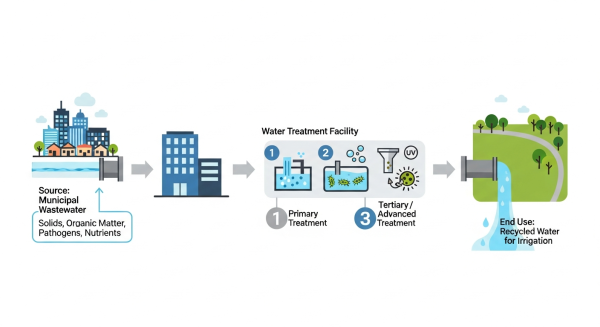
The multi-stage treatment process transforms municipal wastewater into safe, usable recycled water for applications like landscape irrigation.
The process begins with the collection of municipal wastewater. This complex mixture contains a variety of contaminants, including solids, organic matter, pathogens, and nutrients, which must be removed through a series of treatment stages before the water can be safely reused.
The Initial Steps: Primary and Secondary Treatment
Initial treatment focuses on removing the bulk of impurities. Primary treatment involves physical processes to settle out larger solids. Secondary treatment then employs biological processes, where microorganisms consume dissolved organic matter. While these stages remove significant pollutants, the resulting water often requires further purification for many reuse applications.
Beyond Basic: The Science of Advanced Water Purification
Tertiary Treatment: The Gateway to High-Quality Recycled Water
For higher-grade applications, including sophisticated irrigation, groundwater recharge, and eventually potable reuse, tertiary treatment is essential. This advanced stage goes beyond primary and secondary processes, employing methods like filtration, disinfection (e.g., UV or chlorination), and nutrient removal to achieve a higher standard of water quality.
Advanced Purification Technologies: Ensuring Purity and Safety
Technologies such as Reverse Osmosis (RO) represent the pinnacle of water purification. RO utilizes a semi-permeable membrane to remove dissolved salts, minerals, and a wide range of microscopic contaminants, producing exceptionally pure water. This level of purification is critical for applications where water quality is paramount, ensuring safety and efficacy.
Diverse Applications: Where Recycled Water Makes an Impact
Traditional & Essential: Irrigation and Industrial Use
One of the most widespread applications for recycled water is irrigation, serving landscapes, agriculture, and golf courses. It’s also vital for various industrial processes, such as cooling towers and manufacturing, where the use of potable water can be reduced significantly.
Replenishing Our Resources: Groundwater Recharge
Recycled water can be used to replenish depleted groundwater aquifers, a process known as groundwater recharge. This not only conserves precious underground water reserves but also helps prevent land subsidence and saltwater intrusion in coastal areas.
The Frontier of Water Reuse: Potable Applications
The most advanced forms of water reuse involve potable applications. Indirect potable reuse (IPR) involves introducing purified water into natural water sources, like rivers or reservoirs, which then undergo further natural and engineered treatment before becoming part of the drinking water supply. Direct potable reuse (DPR) involves introducing highly purified water directly into the potable water distribution system after rigorous treatment and monitoring.This is where Irrigation Flow Restrictor Screen may be helpful.
Emerging Opportunities: Stormwater Runoff Capture and Reuse
Stormwater runoff, often a source of pollution, presents an emerging opportunity for water reuse. Capturing and treating this water can reduce the burden on sewer systems and provide an additional source for non-potable uses, especially in urban environments.
The Critical Role of Identification: Why Purple Matters
The Universal Symbol: Purple as the Indicator of Reclaimed Water
Across the globe, a consistent visual language is used to identify non-potable water systems. The color purple has been universally adopted as the standard indicator for reclaimed water and is used for products such as recycled water valve box tags and non portable recycled water purple tags This consistent color coding is crucial for immediate recognition.
Regulatory Compliance and Public Safety: Protecting Communities
Clear identification is not merely a best practice; it’s a regulatory requirement in many regions. Proper labeling ensures that personnel and the public can easily distinguish between potable and non-potable water sources, safeguarding against accidental consumption and protecting public health.
Preventing Cross-Contamination: The Importance of Clear Labeling
The risk of cross-contamination between potable and recycled water systems is a significant concern, particularly as water reuse expands to include more advanced applications. Robust labeling systems, such as those provided by Irrigation Tag Supply, are indispensable in preventing these dangerous mix-ups.
Irrigation Tag Supply’s Product Lineup: Essential Tools for Responsible Water Management
Comprehensive Identification for Non-Potable Water Systems
Irrigation Tag Supply offers a comprehensive range of durable, weather-resistant tags and markers specifically designed for recycled water systems. Our products clearly communicate the non-potable nature of the water, covering applications from simple irrigation lines to complex municipal distribution networks.
Ensuring Compliance and Safety Across the Reuse Spectrum
Whether for landscape irrigation, industrial use, groundwater recharge, or supporting the infrastructure for future potable reuse, our identification solutions help facilities meet stringent regulatory requirements and uphold the highest standards of public safety.
Quality, Durability, and Visibility: The Irrigation Tag Supply Advantage
Our tags are engineered for longevity and visibility in demanding environments. They resist fading, corrosion, and damage, ensuring that critical safety information remains clear and legible for the lifespan of the system.
The Future of Water: Sustainability, Innovation, and Irrigation Tag Supply
Addressing Global Water Challenges Through Advanced Reuse
The challenges of water scarcity require innovative solutions like advanced water reuse. As technologies evolve and public acceptance grows, the scope of water reuse will undoubtedly expand, becoming an even more integral part of sustainable water management strategies worldwide.
The Role of Infrastructure and Public Acceptance in Water Reuse Growth
Building robust infrastructure and fostering public trust are key to unlocking the full potential of water reuse. Clear communication, exemplified by effective identification systems, plays a crucial role in this process.
Irrigation Tag Supply: Your Partner in Sustainable Water Management
We are committed to supporting the responsible expansion of water reuse. Our product lineup provides the essential clarity and compliance tools needed by utilities, engineers, and facility managers to implement safe and effective recycled water systems.
Conclusion: Driving Forward with Clarity and Commitment
The journey of water reuse is complex, encompassing advanced treatment processes from primary and secondary stages through sophisticated tertiary purification, including technologies like Reverse Osmosis, to meet diverse needs like irrigation, groundwater recharge, and the frontier of potable reuse, including indirect and direct potable reuse. Integral to this entire spectrum, from municipal wastewater management to the potential of stormwater runoff capture, is the undeniable necessity of clear identification. The universal symbol of purple color alerts us to non-potable water, a critical measure for regulatory compliance, public safety, and preventing cross-contamination. Irrigation Tag Supply is dedicated to providing the high-quality, durable, and visible identification solutions that empower responsible water management. By partnering with us, you ensure your systems are compliant, safe, and clearly communicated, contributing to a more sustainable water future for all. Come check us out for Irrigation tags for sale today.
Irrigation Tag Supply
Laguna hills, California
office@irrigationtagsupply.com
Company Details
Organization: Irrigation Tag Supply
Contact Person: Irrigation Tag Supply
Website: https://irrigationtagsupply.com/
Email: Send Email
Address: Laguna hills, California
Address 2: Laguna hills, California
City: Laguna hills
State: California
Country: United States
Release Id: 22042644287