
Pump.fun Volume Bot Launches King of the Hill Trending Engine for Solana

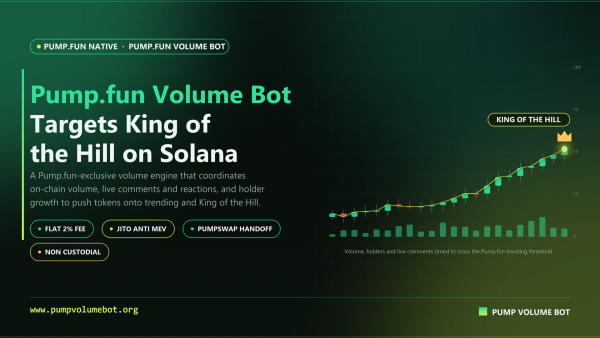
Estonia, 24th Jun 2026 – Pump Volume Labs has opened general availability of Pump Volume Bot, accessible at www.pumpvolumebot.org, a Solana volume engine built exclusively for Pump.fun. Rather than a multi-chain tool adapted to fit, the Pump.fun Volume Bot is engineered around the venue’s own discovery funnel — the fair-launch bonding curve, the King of the Hill leaderboard, the trending board, and the graduation handoff into an AMM pool. The platform coordinates a rotating ephemeral wallet fleet, live comments and reactions threaded on the token’s Pump.fun page, four named volume curves, anti-MEV Jito routing, and automatic migration into PumpSwap or Raydium, all from a browser dashboard under a flat two-percent fee, with no custody of user funds and no KYC.
The Pump.fun Discovery Funnel and Where Tokens Get Found
Every Pump.fun token begins on a fair-launch bonding curve and, as activity builds, moves through a sequence of discovery surfaces that decide whether anyone outside the launch ever sees it. King of the Hill is the leaderboard slot where tokens with recent velocity and social momentum surface. The trending board is where sustained activity holds visibility. Graduation is the moment the bonding curve fills and the token migrates into an AMM pool, where aggregators list the new pair and a fresh wave of traders who never opened Pump.fun discovers it. Pump Volume Bot is built around this exact sequence, treating each surface as a distinct objective rather than producing undirected volume and hoping the venue notices.
This venue-specific design is the difference between a generic Solana Volume Bot and a tool aligned with how Pump.fun actually ranks and surfaces tokens. Each signal the engine produces maps to a specific stage of the funnel, and the timing of those signals is synchronized to the windows Pump.fun samples.
King of the Hill: Timing the Signals That Cross the Threshold
King of the Hill placement is not awarded for raw volume alone. Pump.fun weighs recent velocity across several inputs at once, so a token that produces volume without matching holder and comment momentum surfaces poorly. Pump Volume Bot includes a dedicated trigger module that times volume, fresh holders, and comment velocity together to cross the King of the Hill and trending thresholds as a single coordinated push rather than three independent streams. Burst mode aligns activity to the minute-edge windows the board samples, and a unique-holder bias weights the fleet toward fresh wallets so the holder count buyers actually check rises in step with the volume. Holder growth is paced on a believable curve — a steady rise rather than an abrupt jump — because a natural-looking holder list is part of what sustains a King of the Hill slot once it is reached.
Live Comments and Reactions Threaded in Context
Pump.fun token pages carry a live comment feed, and the venue weighs comment and reaction velocity as part of its momentum signal. Pump Volume Bot produces comments and replies on cadence, threaded so the page reads as a conversation in which messages answer each other in context rather than a list of disconnected one-liners. Comments are drawn from a curated library written in native dialect rather than machine translation, and reactions and upvotes are deployed from distinct wallets to support the social momentum the board samples. Comment density and reaction density are independently configurable per session, per-action timing variation keeps the cadence naturally irregular, and activity is weighted to the waking hours of the token’s target regions so the feed tracks a believable daily rhythm.
The Trade Engine: Four Volume Curves and Natural Timing
The trade engine ships with four named volume curves. Gradual produces a slow, steady climb that reads as organic accumulation. Burst delivers fast activity in short windows for launch moments and trending pushes. Stealth runs quiet accumulation with a low profile. Whale interleaves occasional large swings with scattered micro-buys to reproduce a varied, lifelike tape. Underneath every curve, trade intervals are Poisson-distributed across seconds to minutes so no two gaps repeat and the timeline is full of believable lulls and bursts, sizes are scattered from small to mid to large swings, priority fees are auto-tuned to live Solana congestion to keep confirmation rates high, and slippage is calculated per transaction from current pool depth. The buy-to-sell ratio is configurable per session, and per-trade SOL amounts are bounded by a user-defined range.
The Wallet Fleet: Fresh, Rotated, Naturally Distributed
Each session draws a fresh ephemeral wallet fleet, generated new per run with no address reuse across sessions. The deposit is dispersed across the sub-wallets in randomized, non-identical amounts so the funding pattern varies wallet to wallet. The engine enforces spacing so the fleet stays naturally distributed across the chain rather than concentrated, regional RPC routing spreads the footprint across geographies rather than a single datacenter, and dust is swept with residual SOL returned at session end. A premium aged-wallet option can draw on addresses with prior on-chain history where additional realism is required.
Anti-MEV Routing and Execution Integrity
Every trade is submitted through Jito private bundles rather than the public Solana mempool, which protects fill quality across the many trades a session generates by keeping orders out of reach of sandwich and front-running bots, and Jito tips are randomized per transaction. Below the bundle layer, every signature uses an ephemeral keypair with no reuse, block-gap rules keep two fleet trades from landing in adjacent blocks, small randomized timing gaps keep paired trades naturally irregular, and validator hop variation produces realistic confirmation patterns. The combined effect is execution that produces naturally-varied, organic-looking on-chain behavior rather than a uniform, repetitive footprint.
Block-by-Block Graduation to PumpSwap and Raydium
The most valuable minutes of a Pump.fun token’s life occur at graduation, when the bonding curve fills and the token migrates into an AMM pool — PumpSwap, the venue’s own automated market maker, or Raydium — and aggregators such as Dexscreener, Jupiter, and Birdeye list the new pair. A tool that does not track this handoff loses its momentum at the exact moment the token becomes broadly tradeable. Pump Volume Bot detects the graduation block-by-block and re-routes execution to the new PumpSwap or Raydium pool with no downtime, carrying trending momentum straight through the migration. Optional cross-DEX mirroring then distributes activity across Raydium, Meteora, and Orca for multi-venue visibility. For operators who need a Pump fun trending bot that survives the graduation boundary, the automatic handoff is the decisive feature.
Browser Dashboard Control
The platform runs from a browser dashboard organized into Create, Active, and History sections. The Create section exposes every parameter — wallet count, min and max trade size, strategy preset, duration, comment density, reaction density, buy-to-sell ratio, volume curve, and advanced routing toggles for anti-MEV, graduation auto-handoff, natural distribution, private geo-RPC, smart slippage, block-gap rules, and fresh wallets — alongside a live session preview that estimates wallets deployed, trades executed, comments and reactions fired, unique holders, and session length. The Active section streams live campaign cards with progress and one-tap pause, resume, and stop. The History section archives completed campaigns. Sessions can be scheduled to a precise UTC start, run concurrently across several Pump.fun tokens, saved as reusable presets, and exported to CSV for post-session analysis.
Non-Custodial by Design With Instant Refund
The engine never takes custody of operator funds. The operator funds a deposit wallet they control; the engine derives ephemeral session sub-wallets from that deposit, runs the campaign, and discards them at session end, and the primary wallet’s private key is never requested. Unused deposit is refunded automatically the moment a session is stopped, settled on chain within the same block window, with no support ticket and no lockup. Because the platform holds nothing, the most a session can cost is the SOL committed to it — the custody risk that custodial tools carry is removed by design.
Flat 2% Pricing With Every Cost Inside
Pump Volume Bot charges a single flat fee of two percent on target volume, and that fee is genuinely all-inclusive. It covers Solana network fees, congestion-tuned priority fees, randomized Jito tips, wallet-fleet funding and dispersal, the comment and reaction layers, MEV-protective private routing, optional cross-DEX mirroring across Raydium, Meteora, and Orca, dust cleanup, and the dashboard. A 100 SOL target costs 2 SOL all-in; a 500 SOL target costs 10 SOL all-in. Sessions range from 50 to 5,000 SOL of target volume, the math is reconcilable in advance and auditable on Solscan after the session, and there are no subscriptions, no gas top-ups, and no per-wallet markups.
Common Questions About the Pump.fun Volume Bot
What makes Pump Volume Bot specific to Pump.fun? It is built around the venue’s own discovery funnel — bonding curve, King of the Hill, trending board, and graduation into PumpSwap or Raydium — and produces the native signals Pump.fun weighs, including live comments, reactions, and holder velocity, timed to the windows the board samples.
Is the Pump.fun Volume Bot custodial? No. The operator funds a deposit wallet they control, the engine derives ephemeral session sub-wallets, and unused SOL is refunded the moment a session stops. The platform never holds funds outside an active session and never requests a private key.
Does it handle graduation to PumpSwap? Yes. The engine detects the bonding-curve graduation block-by-block and re-routes execution to the new PumpSwap or Raydium pool with no downtime, with optional mirroring across Meteora and Orca.
Does it require coding? No. The full workflow runs in a browser dashboard with no scripts, no command line, and no client software.
Can the Pump.fun Volume Bot guarantee a token reaches King of the Hill? No, and the platform does not claim it. The engine produces the visibility inputs Pump.fun samples, which raise a token’s probability of placement, but the outcome depends on token quality, external audience, and the competitive density of the board at session time.
Context for the Pump.fun Launch Market
Pump.fun remains the dominant Solana launchpad, and its discovery funnel — bonding curve, King of the Hill, trending board, and graduation into PumpSwap or Raydium — decides which tokens reach an audience in their first minutes. The tooling around the venue has largely consisted of generic volume bots that produce undirected activity without addressing the specific surfaces Pump.fun ranks on. Pump Volume Bot is a direct response to that gap — a venue-exclusive engine that coordinates volume, live comments, reactions, and holder growth toward King of the Hill and trending, carries momentum through graduation, and prices everything as a single transparent flat fee, available at www.pumpvolumebot.org.
Company Details
Organization: Pump.fun Volume Bot Launches
Contact Person: Triin Aru Kalju
Website: https://www.pumpvolumebot.org/
Email: Send Email
Country: Estonia
Release Id: 24062646441