
Poly Syncer Launches Audited Polymarket Copy Trade Platform

Sweden, 8th May 2026 – https://www.polysyncer.com – Polymarket has had a Polymarket copy trade problem since the day it launched. Every position, every fill, every PnL line on the world’s largest decentralised prediction market is public on Polygon, yet the platform itself provides no native way for users to follow proven traders automatically. The data is there. The execution layer was missing.
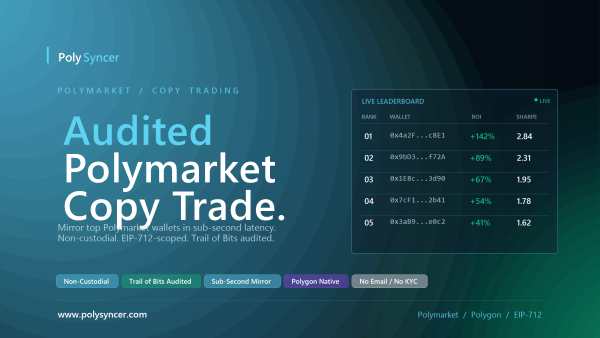
Poly Syncer launches today to close that gap. The platform is a non-custodial Polymarket copy trading service that ranks every public Polymarket wallet by risk-adjusted return, then mirrors the trades of selected wallets directly into the user’s own wallet, typically within sub-second latency. The service has been audited by Trail of Bits in Q1 2026 with no medium-or-higher findings, runs on Rust + Go infrastructure with Flashbots-style private mempool submission, and is now publicly accessible without email, KYC, or behavioural tracking.
Auto Copy Polymarket Without Surrendering Custody
The single hardest design constraint in any auto copy Polymarket workflow is the custody question. Most “copy trading” services in crypto take custody of user funds, run a centralised matching engine, and pay out positions on a delay. Poly Syncer was built specifically to refuse that pattern.
The platform uses EIP-712 typed-data signatures to grant a scoped, on-chain revocable trading permission to its execution engine. The user’s primary wallet stays on the user’s own device. Funds never move through Poly Syncer’s infrastructure. The trading permission can be revoked in a single Polygon block – roughly two seconds. There is no platform-side hot wallet, no commingled treasury, and no path by which Poly Syncer can move user funds to any address other than what the EIP-712 scope explicitly allows.
That non-custodial architecture is enforced down to the operator level: trading keys are held in FIPS 140-2 Level 3 HSMs, service-to-service authentication uses ed25519, and operator keys rotate on a 90-day cycle.
Mirror Polymarket Wallets at Sub-Second Latency
The mechanic that turns Polymarket copy trading from a delayed news feed into something usable is latency. If a top trader’s position is mirrored to a follower 30 seconds later, the price has already moved. Poly Syncer is engineered around eliminating that delay.
On the Elite plan, the platform mirrors Polymarket wallets at a p99 latency of approximately 600 milliseconds from the moment a target trade lands on Polygon. That number is achieved through a co-located node with a direct connection to the Polygon network, a Rust-based listener that subscribes to mempool and confirmation streams in parallel, and Flashbots-style private bundle submission that bypasses the public mempool entirely – both for execution speed and for MEV protection. Every mirrored trade is shielded from sandwich attacks at the routing layer.
Pro plan latency uses premium dedicated RPC infrastructure with slightly higher tail latency, but is still designed to mirror Polymarket wallets in the same trading window as the source wallet, not the next one.
Inside the Polymarket Leaderboard
Poly Syncer’s Polymarket leaderboard is the first place most users land. It refreshes every 60 seconds and ranks every public Polymarket wallet by a composite score that combines Sharpe ratio, ROI, win rate, drawdown, and trade volume – rather than the raw “biggest PnL” leaderboard that surface-level rankings often default to.
Outliers are filtered with a z-score threshold above 2.5, so a single freak trade doesn’t push a wallet to the top of the rankings if its underlying behaviour isn’t repeatable. Wallets can be filtered by 25 prediction market categories – politics, sports, crypto, finance, geopolitics, earnings, tech, culture, world, economy, climate & science, elections, mentions, games, basketball, NBA, movies, soccer, weekly, recurring, Fed rates, business, new listing, trending, and ending-soon markets.
The methodology behind the leaderboard – composite score weights, outlier handling, and backtest protocol – is published in full at the platform’s public methodology page, rather than treated as a black box.
A Smart Money Tracker for Prediction Markets
One of the practical use cases the team has emphasised most consistently is the smart money tracker pattern. Polymarket’s wallets are pseudonymous but transparent. Some have multi-year track records of being right when consensus was wrong. Others post huge volume but underperform on a risk-adjusted basis. Telling the two apart by hand requires hours of on-chain forensic work for every wallet under review.
Poly Syncer collapses that workflow. The leaderboard surfaces the wallets that consistently produce alpha across categories. The portfolio view, dashboard analytics, and per-trader attribution let a user see exactly which copied wallets are driving their own returns over any chosen window. The smart money tracker function is, in effect, an always-on, automated audit of who is actually making money on prediction markets – not who is loudest about it on social media.
Top Polymarket Traders, Ranked Continuously
Identifying top Polymarket traders has historically required a manual process: pulling on-chain CSVs from Polygon, running custom scripts, joining trade data with market resolution outcomes, and adjusting for sample size. Poly Syncer runs that process continuously across the entire Polymarket wallet set and exposes the result through a single ranked interface.
For most users this becomes the entry point: identify a small basket of wallets – typically five to fifteen – that are top performers in the categories the user actually wants exposure to, configure copy ratios per wallet, set risk parameters, and let the engine mirror their trades automatically.
Prediction Market Copy Trading vs Crypto Copy Trading
Prediction market copy trading is a structurally different problem from crypto exchange copy trading. Crypto copy traders deal with continuous markets where slippage, leverage, and funding rates dominate. Prediction market copy trading deals with binary or scalar outcome markets that resolve to a final value – usually with a hard deadline.
That changes the maths in three meaningful ways. Position sizing has to account for total possible loss within an event horizon, not a notional VaR; the platform applies capped fractional Kelly sizing rather than fixed percentage sizing. Liquidity profiles are uneven – sports markets close hours before resolution, election markets thin out in the final week – so timing of mirror execution matters more than in continuous markets. And portfolio correlation has to be tracked across events, not just assets, because a US election outcome can move a dozen different markets simultaneously.
Poly Syncer’s risk model is built around those differences. The portfolio dashboard exposes per-event correlation, per-category exposure caps, stop-loss, take-profit, and a max-drawdown circuit breaker that auto-pauses copy execution if a configurable threshold is hit.
Automated Polymarket Trading From the Browser
The full automated Polymarket trading flow happens entirely in the browser. There is no installer, no desktop client, no server-side trading account. The user connects an EIP-1193 compatible wallet (or a Safe multisig), grants the EIP-712 trading permission with the scope they’re comfortable with, picks the wallets they want to copy from the leaderboard, and configures their risk parameters. From that point, the engine operates 24/7 without further user intervention.
Pre-built strategies are available out of the box for users who don’t want to build a wallet basket from scratch: a Top-10 weighted basket, a Politics conviction strategy, a Sports same-side fade, an Earnings spread, and a Whale-watcher mode. On the Elite plan, a no-code strategy builder lets users compose custom logic without writing a single line of code.
The Polymarket Bot, Without the Polymarket Bot Pitfalls
The phrase “Polymarket bot” has historically been associated with two failure modes: scripts that take custody of user funds and rug, and home-built copy tools that mirror trades on a 30-second delay so noticeable that the alpha is gone before the bot fires. Poly Syncer’s positioning is the deliberate inverse of both – non-custodial by architecture, sub-second by infrastructure, and audited externally by Trail of Bits before the public launch.
The platform also publishes a paid bug bounty (up to $50,000 for critical findings, $15,000 high, $3,000 medium, $500 low) and runs a public security disclosure policy. The threat model and architectural deep-dive are available in the platform’s whitepaper rather than treated as proprietary.
Plans
Poly Syncer is offered in three tiers. The Free plan is genuinely free at $0 and gives new users a working entry point to the engine – copy trading is enabled out of the box, capped at one tracked wallet within a single category, with up to 25 trades per day routed over public RPC at roughly 3-second mirror latency. It is designed as a try-the-engine tier, not a paywalled preview.
The Pro plan is $299 per month and lifts those caps for serious users: up to 250 simultaneously tracked wallets across all 25 categories, unlimited daily trades, premium dedicated RPC at roughly 1.5-second latency, the full risk-control surface (Kelly sizing, stop-loss, trailing stop, daily and weekly loss caps, time-of-day windows, partial copy, auto-rebalance, profit-lock), MEV-protected private mempool routing, and a Pro-tier API at 60 requests per minute.
The Elite plan is $499 per month and removes the wallet cap entirely. It adds a sub-second co-located node (approximately 600 ms p99 mirror latency), AI alpha discovery, hedge mode, mempool sniping, an insider-proximity radar, a no-code visual strategy builder, an 18-month historical backtesting engine, multi-chain readiness (Polygon today, with Base and Arbitrum next), an EIP-712 signed-request API at 600 requests per minute with a raw signal feed, and a personal account manager.
Pricing is paid in stablecoins (USDC on BNB Smart Chain or Ethereum) or by card. Plans renew monthly and can be cancelled from the dashboard in one click. There is no annual lock-in, no setup fee, and no email or phone number is required at any tier.
Privacy by Architecture
One of the more unusual product decisions Poly Syncer has made is the explicit refusal to collect user data. The platform stores no email address, no name, no KYC document, and runs no behavioural analytics. The only personal data it processes is the user’s connected wallet address (necessary for the EIP-712 scope) and a short-lived IP record (used solely for rate-limiting, retained for 7 days). There are no third-party trackers and exactly three first-party cookies: session, CSRF, and theme preference.
That stance carries through to the company’s stated philosophy: build for the patient, refuse data brokerage, and treat non-custody as a non-negotiable.
Availability
Poly Syncer is publicly accessible. Connecting a Polygon-compatible wallet is the only prerequisite. Documentation, the leaderboard, and the strategy library are open to all visitors; copy trading itself activates on the Pro and Elite tiers. The platform is available globally subject to its AML and sanctions policy, which screens against OFAC SDN, EU consolidated, UK HMT, and UN lists at the moment of wallet connection.
Web platform: https://www.polysyncer.com
Company Details
Organization: Poly Syncer
Contact Person: Elon Hedlund
Website: https://www.polysyncer.com/
Email: Send Email
Country: Sweden
Release Id: 08052644827
Disclaimer: This announcement is for informational purposes only and does not constitute financial, investment, or trading advice. Users should conduct their own research before engaging with any platform or services mentioned. Cryptocurrency and prediction markets involve risk, and past performance is not indicative of future results.