
ERC20Token.app Launches No-Code ERC-20 Token Creator

United States, 4th May 2026 – ERC20Token.app has launched a no-code ERC-20 token creator that allows projects, founders and on-chain communities to deploy a fully audited, Etherscan-verified ERC-20 smart contract on Ethereum Mainnet without writing Solidity. Contracts are built on the OpenZeppelin audited ERC-20 library, configured through a browser form, and signed from the user’s own wallet. Ownership of every deployed contract is transferred in full to the deploying wallet at the time of deployment.
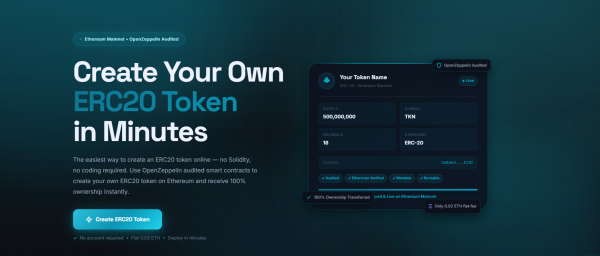
The platform charges a single flat fee of 0.02 ETH. Network gas is paid separately and determined by Ethereum congestion at the time of the transaction. There is no account registration, no subscription, no recurring cost and no retained administrative key.
Specifications at a Glance
The platform deploys exclusively to Ethereum Mainnet (Chain ID 1) using the ERC-20 standard, with every contract built on the OpenZeppelin audited ERC-20 library. Pricing is fixed at a flat one-time 0.02 ETH platform fee, with network gas paid separately and typically falling between 0.001 and 0.005 ETH depending on Ethereum network conditions at the time of the transaction.
Etherscan verification is performed automatically immediately after deployment. Ownership of every deployed contract is transferred 100% to the deploying wallet, with no administrative keys retained by the platform. The token creator integrates with MetaMask, Coinbase Wallet, Brave Wallet, and any EVM-compatible window.ethereum provider. More than thirteen optional contract modules are selectable at deployment, and over 48,000 ERC-20 tokens have been created through the service to date.
Contract Architecture
Every contract generated by ERC20Token.app extends the OpenZeppelin ERC-20 reference implementation. The OpenZeppelin library is the most widely used smart contract framework in the Ethereum ecosystem and has undergone external security review. Using it as the deployment base provides several properties that matter to projects launching publicly on Ethereum Mainnet.
The base ERC-20 logic – balance accounting, transfer rules, allowance management, total supply tracking – matches the canonical ERC-20 implementation studied by auditors and integrated by exchanges and DeFi protocols. Contracts compile to bytecode that Etherscan recognises and matches against verified sources, enabling immediate post-deploy verification. Optional modules such as burnable, mintable and pausable inherit from OpenZeppelin’s audited extension contracts rather than from custom-written logic.
The deployed contract contains no hidden mint functions, no proxy upgrade hatches, no platform-controlled administrative roles, and no re-entrancy or integer-overflow vulnerabilities introduced at the platform layer.
Optional Feature Modules
At the time of token configuration, users can enable or disable a range of contract modules, all included in the flat 0.02 ETH platform fee.
The Burnable module allows holders or the owner to permanently destroy tokens, while Mintable allows the owner to mint additional tokens after deployment to support inflationary or controlled-emission supply models. Pausable lets the owner halt all transfers in response to security incidents or migrations. Deflationary applies an automatic burn on every transfer, gradually reducing total supply over time, and Reflection distributes a portion of every transfer back to existing holders proportionally.
For access control and distribution behaviour, the platform offers Whitelist, which restricts transfers to approved addresses for compliance or staged launch scenarios, and Blacklist, which blocks specified addresses from interacting with the contract. Anti-Whale caps the maximum balance any single wallet may hold, while Taxable deducts a configurable percentage on every transfer to a designated wallet.
Operational modules include Batch Transfers, which enables single-transaction transfers to multiple recipients for airdrops and distributions; Liquidity Pool, which integrates a built-in mechanism for adding initial liquidity; Token Recover, which allows the owner to retrieve other ERC-20 tokens accidentally sent to the contract address; and Max Transaction Limit, which caps the maximum amount transferable in a single transaction.
Modules can be combined in any configuration at deployment time. Once the contract is on-chain, the selected module set is fixed – no upgrade proxy is included by design.
Deployment Workflow
- Configure the token. The user enters token name, symbol, decimal places, and total supply, then selects the optional modules described above.
- Connect a wallet. The platform connects to MetaMask, Coinbase Wallet, Brave Wallet, or any EVM-compatible window.ethereum wallet. No account creation is required.
- Authorise the transaction. The user signs a single transaction that pays the 0.02 ETH platform fee and the network gas, then deploys the contract to Ethereum Mainnet.
- Receive the contract. Once the block confirms – typically under 60 seconds after wallet confirmation – the user receives the contract address, the Etherscan verification link, and full ownership of the contract in their wallet.
The contract becomes immediately listable on Uniswap and other Ethereum DEXs, importable into MetaMask, and visible to portfolio trackers, block explorers, and DeFi aggregators that consume Ethereum on-chain data.
Pricing and Ownership
Pricing is structured as a single platform fee of 0.02 ETH paid in the same transaction as deployment. There are no follow-on charges, no royalty deductions, and no platform retention of administrative privileges over deployed contracts.
Specifically:
The deploying wallet is set as the contract owner via the standard Ownable pattern
Ownership can subsequently be transferred to a multi-signature wallet, DAO governance contract, or any other Ethereum address using the standard transferOwnership() function
The platform retains no override capabilities – it cannot mint, pause, blacklist, or otherwise interact with deployed contracts after the deployment transaction is finalised
Source code for every deployed contract is published on Etherscan as part of the verification step, providing public auditability
Ethereum Mainnet Only
ERC20Token.app deploys exclusively to Ethereum Mainnet (Chain ID 1). The platform does not deploy to Layer-2 networks, sidechains, or Ethereum testnets. Projects targeting other EVM-compatible chains – BNB Smart Chain, Polygon, Arbitrum, Base, Optimism – require separate deployment workflows. The decision to scope to Ethereum Mainnet reflects the platform’s focus on direct ERC-20 deployment in the canonical Ethereum environment, with full Etherscan verification and Uniswap V3 listability from the moment the deployment transaction confirms.
Applications
Across 48,000+ contracts deployed via the platform, project use cases observed include:
DeFi protocol tokens (governance, liquidity mining, fee-sharing)
Community and creator-economy tokens
Loyalty and rewards programmes implemented on-chain
DAO governance and voting tokens
Utility tokens for platform access or in-application payment
Meme coins and community-launched fungible assets
Pre-sale and IDO fundraising vehicles
Airdrop and distribution tokens for existing communities
Availability
ERC20Token.app is publicly accessible. Deployment requires only an EVM-compatible wallet funded with sufficient ETH to cover the 0.02 ETH platform fee plus network gas.
Token creator: https://www.erc20token.app
Documentation: https://www.erc20token.app/docs/
Blog and tutorials: https://www.erc20token.app/blog/
Contact: https://www.erc20token.app/contact/
Company Details
Organization: ERC-20 Token Creator
Contact Person: Yadira Ebert
Website: https://www.erc20token.app/
Email: Send Email
Address: 2029 N Woodlawn St
Address 2: Wichita
Country: United States
Release Id: 04052644643
Disclaimer: This content is provided for informational purposes only and does not constitute financial, investment, legal, or regulatory advice. The creation or deployment of digital assets carries inherent risks.