
TREE MORPHOGENESIS BOOK 2: TREE CODE Explaining Growth Structure and Biological Intelligence

A revolutionary guide to understanding and working with natures greatest structural engineers – Trees
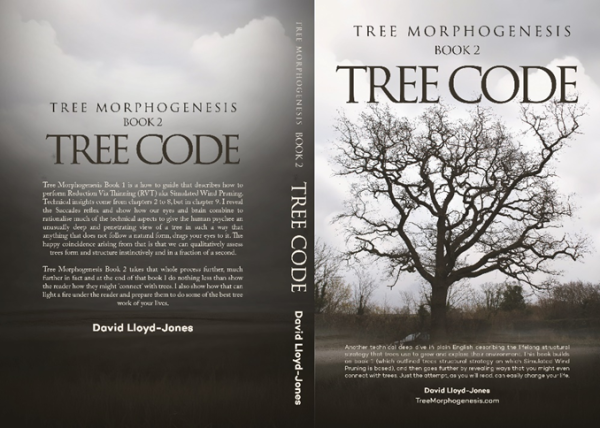
By David Lloyd-Jones
United Kingdom, 27th Jan 2026 – Trees aren’t just background scenery. They are alive in ways that we rarely notice – full of evolved intelligence, strategy. energy and quiet design.
In his new book Tree Morphogenesis book 2: Tree Code, arborist and inventor David Lloyd-Jones digs deep into how trees really work, how they adapt and even communicate but most importantly this work shows how to work with the nature of trees rather than fighting trees natural growth patterns.
Tree Code is far more than a manual, it’s the culmination of a still unfolding life journey. After decades as a contracting Arborist, David distils his experience, research and intuition into a guide that shows readers how to manage and care for trees, in harmony with their natural design and processes.
“This is how I am just beginning to repay my debt to trees”, David writes. “Everything that I have achieved in Arboriculture and in my career (which provided the means to raise my daughters) – comes from them. I owe trees for all the good they brought into my life”.
The Tree Morphogenesis series, available through www.TreeMorphogenesis.com represents the author attempt to begin to address the “gulf of misunderstanding”, that he sees has developed between humanity and trees. Drawing on decades of dedicated research and observation leading to practical application and Case Histories to illustrate the approach, Tree Code invites Arborists, conservationists, aspiring Conservation Arborists and ordinary tree owners to see trees not as static objects but as dynamic organisms capable of extraordinary adaptation and communication.
In his first book David introduces the reader to the principle of “Simulated Wind Pruning” which is a revolutionary concept that mirrors the natural pruning patterns trees experience in the wild. By studying how wind, weather and stress shapes trees over time, he discovered that Arborists can make creative use of these natural triggers for morphology and growth through precise and insightful pruning techniques, all based on this new understanding and the latent sensitivity that humans have which enables them to instinctively assess natural form ( latent sensitivity that David helps expose and develop in the mind of the reader in Chapter 9 of book 1).
In the second book in the series, he takes things a step further. He talks about how tree owners and their Arborists can work with trees instead of just managing them. Trees in urban environments have it tough, boxed in by concrete , stressed by pollution and are constantly adapting to the constraints placed on them that limit their potential.
The key isn’t control but rather co-operation based on understanding. When you understand how a tree uses its energy and reacts to opportunities, you can prune and care for it in ways that work with its higher design so help it grow strong and stay alive.
Pruning becomes communication. It is how we teach the tree where to focus its life energy.
At its core, Tree Code is a guide for anybody who works with trees, but there is more to it than just tips and techniques. David digs into how modern tree care has slipped off track. For decades we have pruned more than was necessary, cutting in less than sympathetic ways and ignoring how trees actually grow. Outcomes can include early decay, low reserves of fuels for cell division, growth and internal defence all of which in an urban environment, result in short safe useful life expectancy.
But here is the twist, nature already worked out what to do. Through real examples and after decades of study, David shows that if we follows nature’s design lead, everything changes. We make trees stronger, preserving their vitality and their ability to hold up their canopies through storms. He points to and explains the lessons right in front of us: how wind shapes branches, how trees heal and wall off defects and how energy flows through the canopy. When we work with these natural systems, these strategies that evolved over hundreds of millions of years, instead of against them, the results are not just better trees but better places to live.
He argues that urban trees have no natural ancestors and no time to genetically adapt to the environments that we force them into. It is an Arborists job to manage that compromise in order to help them thrive and survive. “When we understand how the mature canopy of trees were created by adaptation and closely approximate that process, we gain in terms of safety while preserving the mature tree aesthetics” he writes.
While Tree Code offers clear Science based explanations, it also ventures into the Spiritual and Philosophical realms. David sees trees as mirrors of Human life in that they seek balance through constant adaptation. Like us trees find balance in dynamic equilibrium. Unlike us trees can’t move so they create the structures they need to grow up and dynamically grow down. It is a dance between closed and open systems, between inhibition then occasional release from that inhibition in other words a binary design methodology (long term inhibition then short term activation events) long predicted by prominent mathematicians studying the formation of patterns in nature.
He says, “if you really pay attention to trees, they can teach you a lot about life, how to bend without breaking and how everything is connected. It’s all built on the same rules” he explains.
Another wild though is that trees share more than 60% of our Genes so although profoundly different, we are fundamentally more alike than we think. We are not “apart” from Nature, but we are “of it”. When we remember that we stop trying to impose control but rather, start working in co-operation to guide trees.
Another theme of Tree Code is teamwork. David really leans into the idea that the future of tree care isn’t solely about Arborists doing their job better because it is about everybody working together. That cohesion starts when everybody, the tree owner, Arborist and Tree Officer all have the same understanding and the same words to define concepts. When clients actually get what is happening behind the pruning and know why it matters, something shifts. They stop seeing tree care as just another “black box” service that they are paying for. Instead they take part in the management of their trees. They become caretakers of their own trees which of course makes them the conceptual tree carers engaging Conservation Arborists to do what the tree owner sees as necessary.
“Clients are the tide that floats all ships” he says. When they know more, they expect more but remember, in this discipline, less is more. That means better, more ethical and more sustainable tree work for everybody.
“Education sells itself” he insists. Once Tree Owners see the long term benefits of working with natural design, they become lifelong advocates for sympathetic tree care and the Arborists who provide that service.
Tree Code is not just another book about trees. David doesn’t hold back. He points out how old habits inflexible management systems and fear driven thinking have slowed real progress and the natural evolution of tree care. He makes this smart comparison too – how people once fought against new Scientific ideas in the same way that many resist change today. Tree Code is sharp, honest and meant to shake things up.
He urges readers to question authority, embrace critical thinking and always to approach nature with humility. If anybody tells us “the Science is settled” he writes “question it”. True Science is never “settled” – it is alive, growing and evolving, just like a tree.
Ultimately, Tree Code is an invitation to Arborists, environmentalists, tree owners and tree lovers to align themselves with the structural wisdom of nature by understanding it. Everything flows from that. He reminds us that we are made of the same compressed and transformed sunlight as the trees around us and that our understanding, energy and intentions can positively shape the world we inhabit if we understand it.
This perspective transcends the technical aspects of tree care and becomes something familiar, something deeply Human.”When our thoughts are shaped by that knowledge of how trees really work” he writes, “we become shaped by that knowledge, just as trees are shaped by wind”.
The result is a book that blends practical expertise, with profound philosophy – a rare combination of Science and Soul.
Get ready to explore this synergy of Science and Spirituality through the pages of Tree Morphogenesis book 2: Tree Code, which is now available on Amazon. For more information on the author and his works, visit www.TreeMorphogenesis.com
Website: http://www.treemorphogenesis.com/
Business Email: dlj@treemorphogenesis.com
Company Details
Organization: Tree Morphogenesis
Contact Person: David Lloyd Jones
Website: http://www.treemorphogenesis.com/
Email: Send Email
Contact Number: +447795314202
Country: United Kingdom
Release Id: 27012640533