
Global Claims on India and RSS Must Meet Standards of Evidence

United States, 8th Apr 2026 – International commentary on India’s socio-religious landscape has, in recent years, settled into a pattern of repetition. The same claims surface across academic summaries, advocacy reports, policy recommendations, and media coverage—particularly in relation to the Rashtriya Swayamsevak Sangh (RSS). Over time, repetition has begun to resemble validation. It is not.
The difference between a widely circulated claim and a proven fact remains the same as it has always been: evidence. That distinction becomes critical when narratives move beyond commentary and begin to influence policy positions, diplomatic signalling, and institutional perception.
How Global Narratives Take Shape
Much of this discourse draws upon reports issued by the United States Commission on International Religious Freedom (USCIRF). Its role is clearly defined. It is an advisory body created under the International Religious Freedom Act of 1998. It does not adjudicate disputes. It does not conduct evidentiary hearings. It does not apply standards of proof that would be recognisable in any court of law.

Its reports are compiled from submissions, secondary material, and analytical interpretation. Yet in international circulation, those distinctions tend to disappear. Advisory observations begin to travel as determinations, and interpretations begin to carry the weight of findings.
The pathway is consistent. Academic outputs introduce a frame. Advocacy reports expand it. These reports often rely on overlapping sources, sometimes citing each other, reinforcing internal consistency. Over time, repetition across platforms creates the appearance of corroboration. By the time such narratives enter policy documents, they carry the force of settled truth. Media amplification completes the cycle.
At no stage in this progression is there a requirement for evidentiary testing.
Where the Legal Record Stands
This absence becomes most visible when history is invoked. The Assassination of Mahatma Gandhi remains one of the most scrutinised events in India’s modern past. The man who carried out the act, Nathuram Godse, was tried and convicted through due process.
That outcome has never been in dispute.
What has shifted is the narrative layered around it. The move from individual conviction to institutional attribution continues to appear in international commentary without a corresponding legal foundation.
No court in India has held the RSS responsible for that crime.
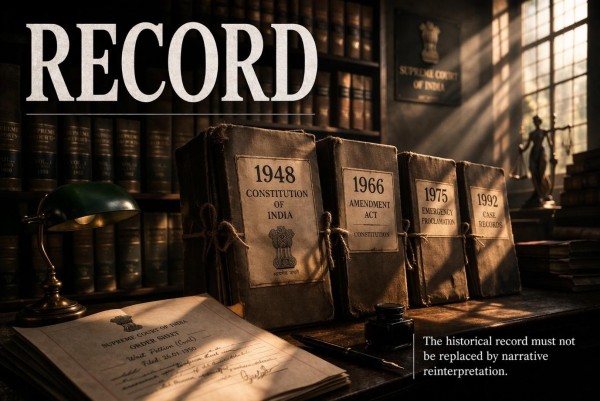
The temporary ban imposed on the RSS after the assassination was an executive decision, not a judicial finding. The distinction is fundamental. The Kapur Commission examined aspects of the broader conspiracy but did not function as a court and did not deliver a binding verdict establishing organisational culpability.
Legal responsibility, in any rule-of-law system, is determined through courts. That principle remains unchanged.
India’s Constitutional Framework
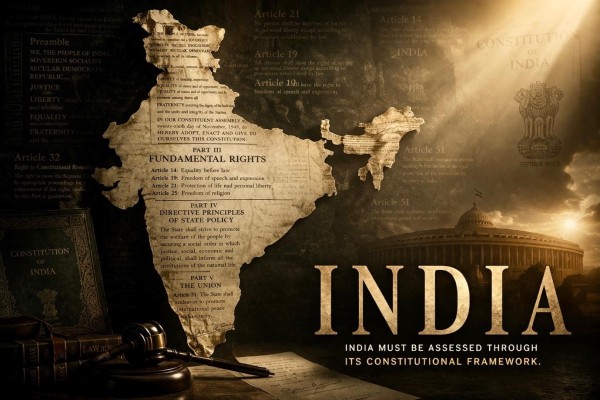
India’s constitutional structure is central to any fair assessment. The Constitution guarantees freedom of religion under Articles 25 to 28, ensuring individuals the right to profess, practice, and propagate religion, subject to public order, morality, and health.
These rights are enforceable through an independent judiciary. The Supreme Court of India has consistently affirmed that allegations must be tested against evidence before they are accepted.
This framework applies equally to all organisations operating within India, including the RSS. Accountability is determined through due process, not through external attribution.
The Accountability Gap in Global Reporting
A broader imbalance emerges in how global narratives are produced. Academic institutions, advocacy groups, and policy bodies play a significant role in shaping discourse. Yet they do not operate under the constraints that define judicial systems.
They are not required to meet burdens of proof. Their claims are not subject to cross-examination. Their conclusions do not carry consequences for inaccuracy.
At the same time, their outputs influence international perception and policy direction.
This creates a structural gap between influence and accountability.
When Narratives Become Policy
The consequences become sharper when narrative turns into recommendation. Calls to classify India under adverse categories or to consider measures against organisations carry real diplomatic and reputational implications.
Such outcomes demand a standard of evidence that matches their impact.
Repetition does not meet that standard. Inter-referential sourcing does not meet that standard. Interpretive layering does not meet that standard.
Primary evidence does.
Court records do. Judicial findings do. Statutory provisions do.
Any credible global assessment must begin there.
India does not stand outside scrutiny. No democracy does. But scrutiny retains its legitimacy only when it remains anchored in verifiable fact. Once that anchor is lost, assessment gives way to assumption.
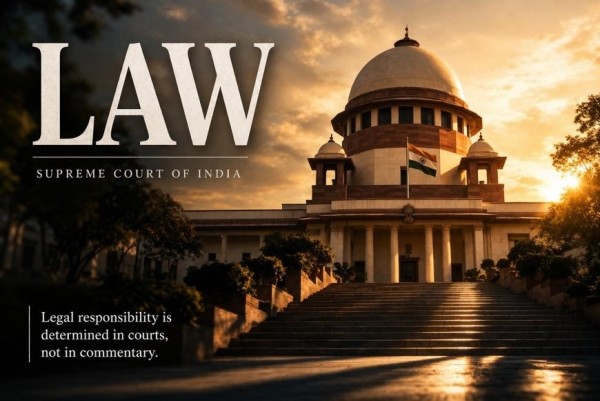
The line is clear and it does not shift: legal responsibility is determined in courts, not constructed through repetition.







Company Details
Organization: FJG- Freelance Journalist group
Contact Person: Jacob stan
Website: http://thefjg.blogspot.com/?m=1
Email: Send Email
Country: United States
Release Id: 08042643832